Wednesday, October 9, 2019

Ex parte Endo: A Late Justice to the Japanese Americans in Internment

The Ex parte Endo case was a late justice to the Japanese Americans in World War II, which greatly showed that Justice won't be absent, but simply too late on its way. When reading Daniels' Coming to America, other ethnic groups, such as Germans and Italian immigrants in the United States, could be differentiated as "good" or "bad", why can't the Japanese be treated in the same way? In this case, Endo was a Nisei, which means second generation Japanese Americans, didn't travel to Japan, didn't speak Japanese, her behavior was totally American, which was no different than the European descendants in the United States. Endo and her parents were forced into internment just because of their ethnicity, and relocated a few times. They ended up staying in Topaz Relocation Camp in Utah, from 1942 to 1945. At the same time, Mistuye Endo, without any consent, served as the chief plaintiff of Ex parte Endo. This case was argued a few times in the district court and finally went to the US Supreme Court in 1944. It was ruled unanimously that the government cannot detain citizens who are loyal to the United States, and finally ended the incarceration of the Japanese Americans. Overall, the justice was too late that Endo and her parents left Topaz when the war almost ends.
Article: Overlooked No More: Mistuye Endo, a Name Linked to Justice for Japanese-Americans - The New York Times

Wednesday, October 2, 2019

A Witness of 20th Century


This article illustrated the experience of a Chinese Immigrant lady, Cecilia Chiang, who recently had her 99th birthday. I found this article from the food section of the New York Times. I thought it would be talking about how Ms. Chiang retained the original flavors of Chinese cuisine in the United States. However, when Ms. Chiang recalled her past in Beijing, and her experience as an immigrant in San Francisco, there was a heavy historical context in it. The life from an upper-class girl, where she was not allowed to approach any kitchen stuff, to the life that she had to making a living using the dishes she remembered back in China. Ms. Chiang remembered her 99 years of life. Her life was just like a collection of history that should be treasured.
Article: Cecilia Chiang, a Pioneering Restaurateur, Marks a Century of Flavors - The New York Times

Wednesday, September 25, 2019

Yickwo v. Hopkins: An Early Landmark Victory Against Racism

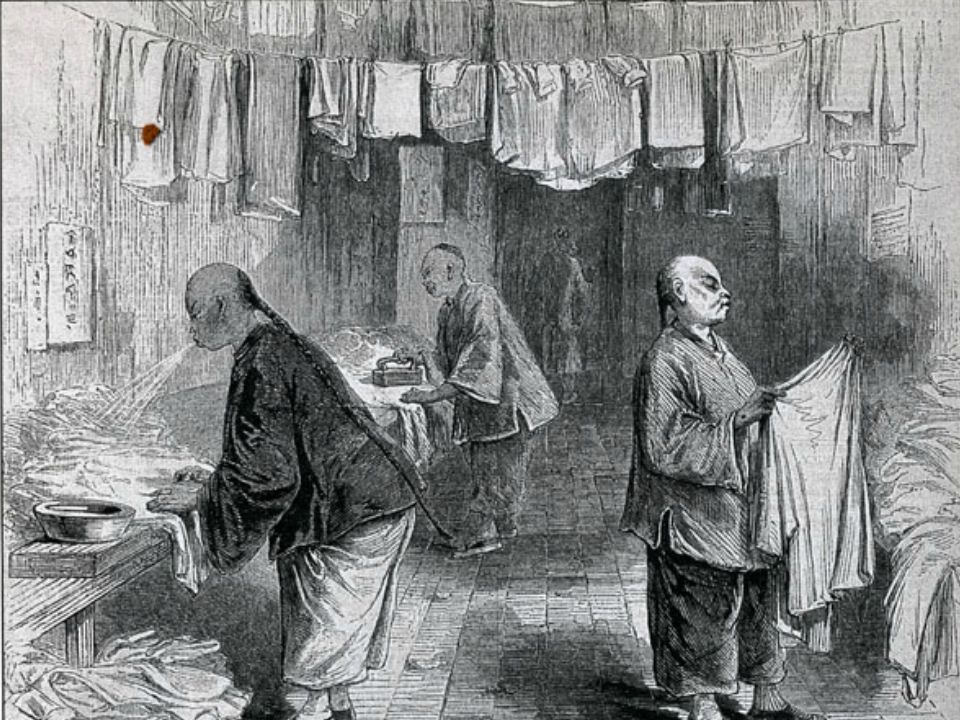
Chinese immigrants were once a clear target of white supremacy in America. In the 19th century, it was impossible for Chinese immigrants to assimilate into American society due the differences in appearance and culture. When I was studying supreme court cases about the Civil Rights Movement, the case of Yickwo v. Hopkins (1886) was introduced as a landmark victory that many Civil Rights case referred to this court decision. This articles I found online is interesting, it introduced how the Chinese went into the laundry business after the gold rush. Many Chinese originally refused to wash clothes because it should be women's job for laundry. However, the foreign miners' tax imposed to the Chinese forced them to change their career. Later, an anti-laundry legislation to the Chinese immigrants in California has forced them to appeal it to the court and finally overturn this legislation unanimously. This case might not change much about the situation of Chinese immigrants in America during 19th century, but at least the immigrants could still make a living in a place far from their homes.
Article: Yick Wo: How A Racist Laundry Law In Early San Francisco Helped Civil Rights

Wednesday, September 18, 2019

Chinatown tong wars in San Francisco

This article was talking about the tong wars in San Francisco presented me how brutal the conflicts were among Chinese immigrants back in the 19th century. It was ridiculous that how woman became the source of a conflict and ended with deaths and casualties. On the other hand, the Chinese Squad, employed by the San Francisco government, were no different than the tong members. They often break into tong headquarters and destroy the furniture inside. It was their way to scare tong members away from battling. However, American tongs surprisingly worked together in supporting Dr. Sun Yatsen for overthrowing the Qing Dynasty (1644-1911). It was probably because they hated Qing Dynasty than anybody in China. The tongs in America consisted with people from Hongmen, who claimed to restore the previous Ming Dynasty (1368-1644) in China, and some remnants of Taiping Rebellion (1851-1872).
Article: Chinatown tong wars- The San Francisco Examiner

Wednesday, September 11, 2019

Curry: Food That Travels Through Colonization

Today, the article about Japanese curry bricks in the New York Times resonates me as a curry lover. Curry is a food that is unable to bypass among the countries that was heavily influenced by the Great Britain, while it was in its peak of influence. In the mid-19th century, British Empire officially colonized India, and the recipe of cooking curry flew across the Indian Ocean to the East Asian nations in the 19th century. During this period of time, Japan was facing Meiji Restoration. The Japanese assimilated many European dishes into their own style, including the Curry. Even though many Southeast Asian countries have their unique curry recipes, the Japanese is the only country that converted curry into bricks where we can simply enjoy curry instantly. I have to say, the Japanese contributed much in making instant food in the last few decades.
Article: The Secret to Japanese Comfort Food on Demand: Homemade Curry Bricks- The New York Times

Wednesday, September 4, 2019

How a writer back in 19th century viewed Chinese immigrants in California

For Chinese Immigrants, California is often the best location to live in the United States because it faces the Pacific Ocean. The coastal cities of California are closer to their homeland. Mark Twain, a famous American writer, wrote some observations about Chinese immigrants in California when he was traveling to the American West during the 1860s. He described that the Chinese immigrants always herd together. In their ethnic community, these immigrants often provide washing, ironing, and catering services that were relatively cheaper than the ones from White Americans. Overall, Twain had positive views on Chinese immigrants. He stated that the Chinese immigrants were able to find themselves a job to do, and worked very hard in their careers. In this article, Twain compared Chinese immigrants with the White Americans. Therefore, I think Twain just wanted to use Chinese immigrants to criticize the behaviors of White Americans, who have higher status in the United States.
Article: Mark Twain’s Observation About Chinese Immigrants in California

Wednesday, August 28, 2019

Vietnamese Rice Rolls: Banh Cuon


Last weekend, I went to the Vietnam Town in San Jose with my sister. We ate Vietnamese rice rolls, where it should be called Banh Cuon, according to the article in The New York Times. It was a fresh experience for me, because I only know Pho in Vietnamese cuisine before. As a Cantonese, I never thought that Vietnamese food actually shares a lot of similarity with the Cantonese. In Hong Kong, I often eat Cheung-fun, something similar to Banh Cuon during the Yumcha session. The article also mentioned they are relatively similar. However, making Cheung-fun is not easy. It requires some skills to make Cheung-fun in Yumcha restaurants. My sister said, Banh Cuon is more like a casual formula of making Cheung-fun, which makes it easier to make in the household. It was interesting to see how immigration from other countries affected the meals in the United States. The various cuisines in this country showed its complicated ethnic history in its 243 years of establishment.

Solemn Remembrance of Thanksgiving