Tuesday, October 29, 2019

Racial Discrimination to Native Americans Today

Salt River High School's gymnasium, home of the Eagles volleyball team. (Google Street View)
The Racial Discrimination in the United States seemed endless. After finding a photographic article about the Alcatraz Island in 1969. There is another article illustrating the racial discrimination to Native American athletes in Arizona today. Arizona has the largest indigenous population in the United States. However, their reserved land were often invaded by the government by turning them into internment camps in World War II or selling them to the mining companies. Today, the Native American volleyball players were harassed by the audience and were called "savages." It is hard to believe that the United States still cannot achieve some kind of mosaic, where racial discrimination remains to the people who are not "white."
Article: Native American volleyball players were called 'savages.' They walked out of the match for safety reasons. - The Washington Post

Wednesday, October 23, 2019

Alcatraz Island: Struggle for Native Americans from being Assimilated

This article showed that the myth of "melting pot" in America is really just a myth. Native Americans are always forgotten by the society. If the New York Times didn't really report about it, I would have thought that Native tribes are history and does not really exist anymore. In November 20, 1969, a group of Native Americans occupied Alcatraz Island in the Bay Area, showing that there are still Native tribes exist in America and they resisted to be assimilated by the American society created by the immigrants. The situation in the United States is more like mosaic, which is how Canadians use to describe their society. Mosaic deems the cultural differences between the ethnic groups but conflict will arise if is not well dealt.
Article: Occupy Alcatraz: Native American Activism in the Modern Era - The New York Times

Tuesday, October 15, 2019

Somali-Americans in Minnesota

Representative Ilhan Omar at a dinner for the Human Rights Campaign on Saturday.
The actual condition of Somali-Americans is so different from what President Trump said. Originally, I was skeptical on the conditions of immigrants in the inland areas of the United States. There are rumors that people from inland areas are not friendly to non-white Americans. But it is not that case. The New York Times interviewed Somali-Americans in Minnesota about their feelings about immigrating to America. They said it is like home compared to the unrest in Somalia. The possible reason of being targeted might be Rep. Ilhan Omar's distinctive presence in the Congress. Just like other ethnic groups in the past, I believe time could silence discrimination.
Article: 'This Creates Fear': Trump Rally Turns Spotlight on Minnesota's Somali Community - The New York Times

Wednesday, October 9, 2019

Ex parte Endo: A Late Justice to the Japanese Americans in Internment

The Ex parte Endo case was a late justice to the Japanese Americans in World War II, which greatly showed that Justice won't be absent, but simply too late on its way. When reading Daniels' Coming to America, other ethnic groups, such as Germans and Italian immigrants in the United States, could be differentiated as "good" or "bad", why can't the Japanese be treated in the same way? In this case, Endo was a Nisei, which means second generation Japanese Americans, didn't travel to Japan, didn't speak Japanese, her behavior was totally American, which was no different than the European descendants in the United States. Endo and her parents were forced into internment just because of their ethnicity, and relocated a few times. They ended up staying in Topaz Relocation Camp in Utah, from 1942 to 1945. At the same time, Mistuye Endo, without any consent, served as the chief plaintiff of Ex parte Endo. This case was argued a few times in the district court and finally went to the US Supreme Court in 1944. It was ruled unanimously that the government cannot detain citizens who are loyal to the United States, and finally ended the incarceration of the Japanese Americans. Overall, the justice was too late that Endo and her parents left Topaz when the war almost ends.
Article: Overlooked No More: Mistuye Endo, a Name Linked to Justice for Japanese-Americans - The New York Times

Wednesday, October 2, 2019

A Witness of 20th Century


This article illustrated the experience of a Chinese Immigrant lady, Cecilia Chiang, who recently had her 99th birthday. I found this article from the food section of the New York Times. I thought it would be talking about how Ms. Chiang retained the original flavors of Chinese cuisine in the United States. However, when Ms. Chiang recalled her past in Beijing, and her experience as an immigrant in San Francisco, there was a heavy historical context in it. The life from an upper-class girl, where she was not allowed to approach any kitchen stuff, to the life that she had to making a living using the dishes she remembered back in China. Ms. Chiang remembered her 99 years of life. Her life was just like a collection of history that should be treasured.
Article: Cecilia Chiang, a Pioneering Restaurateur, Marks a Century of Flavors - The New York Times

Wednesday, September 25, 2019

Yickwo v. Hopkins: An Early Landmark Victory Against Racism

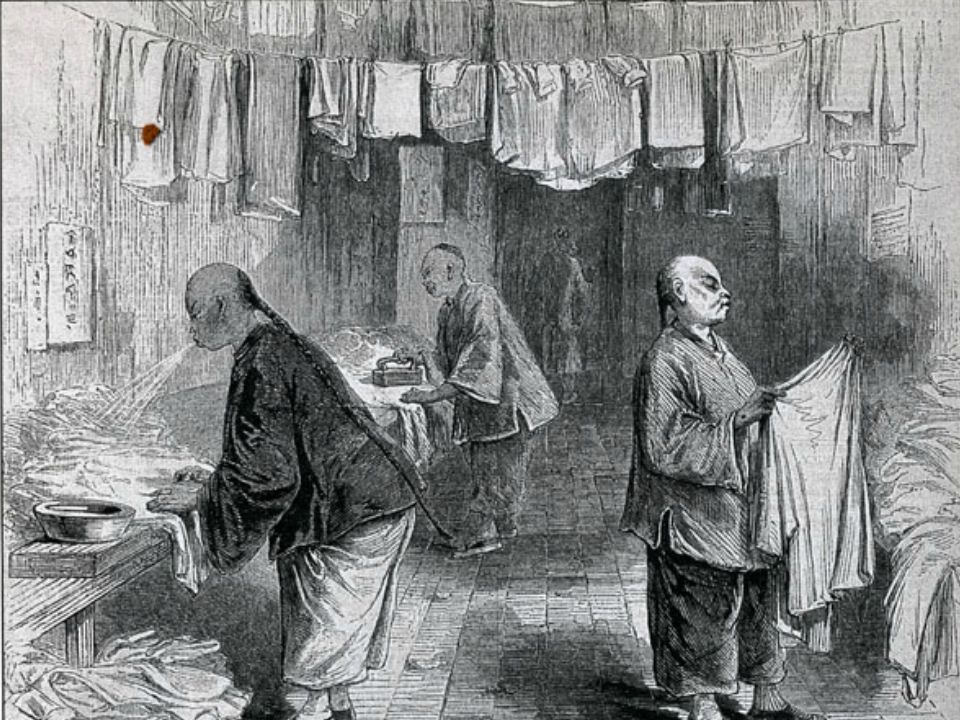
Chinese immigrants were once a clear target of white supremacy in America. In the 19th century, it was impossible for Chinese immigrants to assimilate into American society due the differences in appearance and culture. When I was studying supreme court cases about the Civil Rights Movement, the case of Yickwo v. Hopkins (1886) was introduced as a landmark victory that many Civil Rights case referred to this court decision. This articles I found online is interesting, it introduced how the Chinese went into the laundry business after the gold rush. Many Chinese originally refused to wash clothes because it should be women's job for laundry. However, the foreign miners' tax imposed to the Chinese forced them to change their career. Later, an anti-laundry legislation to the Chinese immigrants in California has forced them to appeal it to the court and finally overturn this legislation unanimously. This case might not change much about the situation of Chinese immigrants in America during 19th century, but at least the immigrants could still make a living in a place far from their homes.
Article: Yick Wo: How A Racist Laundry Law In Early San Francisco Helped Civil Rights

Wednesday, September 18, 2019

Chinatown tong wars in San Francisco

This article was talking about the tong wars in San Francisco presented me how brutal the conflicts were among Chinese immigrants back in the 19th century. It was ridiculous that how woman became the source of a conflict and ended with deaths and casualties. On the other hand, the Chinese Squad, employed by the San Francisco government, were no different than the tong members. They often break into tong headquarters and destroy the furniture inside. It was their way to scare tong members away from battling. However, American tongs surprisingly worked together in supporting Dr. Sun Yatsen for overthrowing the Qing Dynasty (1644-1911). It was probably because they hated Qing Dynasty than anybody in China. The tongs in America consisted with people from Hongmen, who claimed to restore the previous Ming Dynasty (1368-1644) in China, and some remnants of Taiping Rebellion (1851-1872).
Article: Chinatown tong wars- The San Francisco Examiner

Solemn Remembrance of Thanksgiving